The AI Police Are Arresting the Wrong People
A coffee shop, a music video and a woman with a poster walk into a comment section. Guess who never gets yelled at.
In this essay
Recently, I watched an interview with a woman who'd made a music video. She and her team made the thing themselves, then used a few AI tools to enhance it. She said so, out loud, on camera, which was her first mistake.
My mistake was scrolling down.
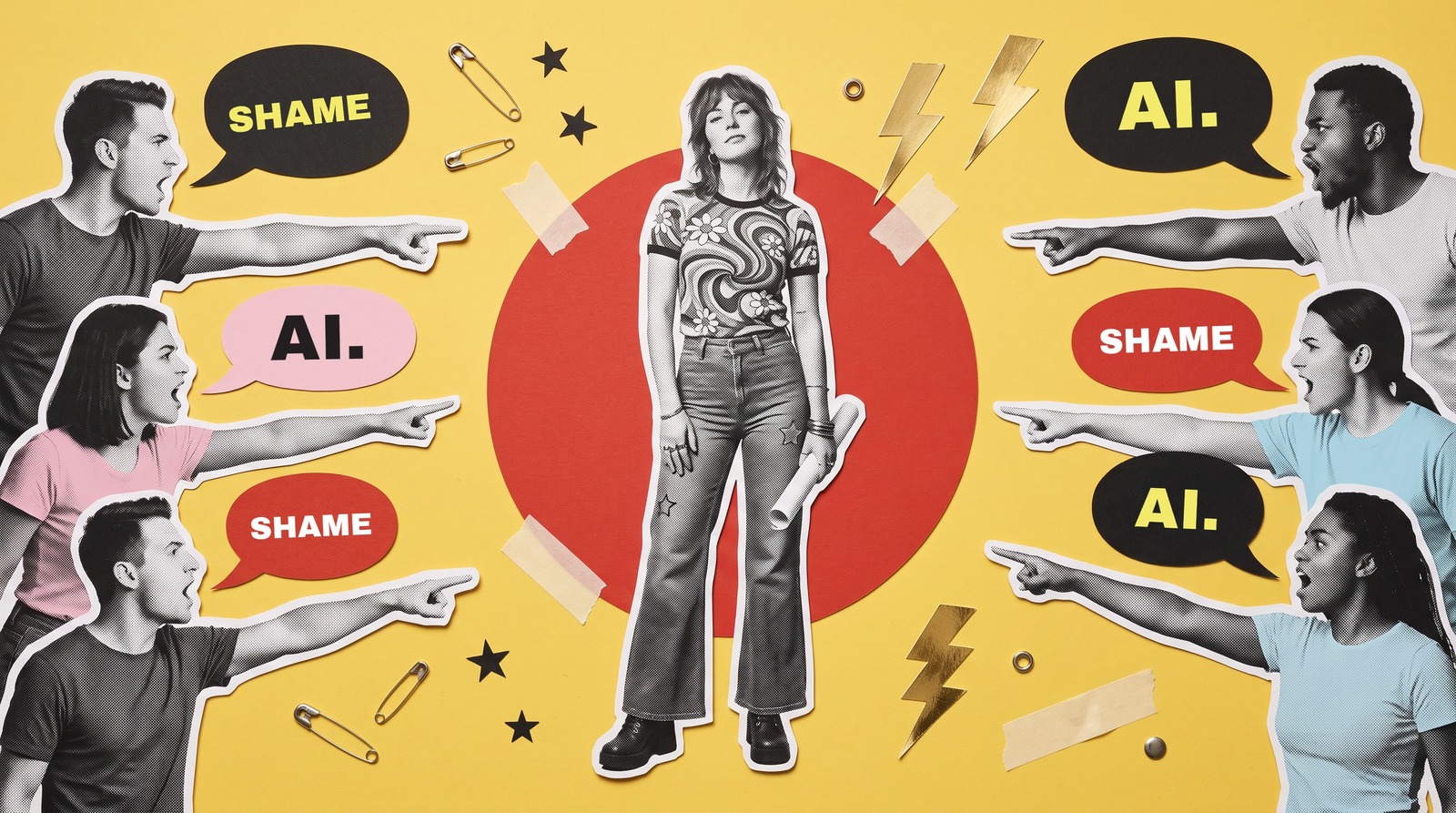
Go die. You're unethical. You're the worst. A whole comment section had convened a tribunal under a clip about a music video, and the verdict was in before the chorus.
It's everywhere once you see it. On Threads, a small business owner asked a question about her poster, a poster that was pretty clearly made with AI, and strangers lined up to tell her what kind of person she was. On TikTok, you can open almost any post that used the stuff and find the same comment stacked 40 deep.
AI.
AI.
AI.
As if the rest of us had missed it. As if typing it were a public service.
Who deputized the comment section?
The comment section
Tap a bubble to see who it landed on
The 7-year-old at the keyhole
In George Orwell's "1984," published in 1949, there's a neighbor named Parsons: sweaty, cheerful, loyal to the Party in the way a golden retriever is loyal to a tennis ball. He ends up in a cell anyway. His daughter, age 7, listened at the keyhole, heard him mutter against Big Brother in his sleep and reported him to the patrols the next day.
Parsons is proud of her.
Orwell knew the scariest enforcer in a nervous society isn't the government. It's the kid who's been handed a rule and a whistle and has just found out how good it feels to blow it.
It's the kid who's been handed a rule and a whistle and has just found out how good it feels to blow it.
Earlier this month, I wrote about how we all became judges without ever being students. Consider this the sequel. We got bored of judging and joined the force.
Ask Megi Endeladze. She owns Penny's Coffee Shop in Buffalo, New York, and this fall, according to Business Insider, the barista who made her chalkboard signs had moved away and she had a newborn at home. So she had ChatGPT make a seasonal menu poster, paid about $150 to print it and posted a photo. The replies came fast. Commenters called it slop, one typed "SHAME SHAME SHAME," and then came about 100 unfollows and a message from a much bigger account telling her to take the sign down or it would post about her. She apologized, promised the shop wouldn't use AI for its menus again and asked people to be kind.
A new mother with a fall menu. Public enemy No. 1.
How would the sticker shop even know?
There's a sticker printer out there whose whole pitch is that it won't take AI art. No AI, no exceptions. It's their press and their rule, and plenty of customers love them for it.
But I've been a designer long enough to ask the boring question. How would they know?
If a graphic designer uses AI to rough out a layout, extend a background or clean up a line, then finishes the piece by hand, there's nothing left to catch. The detection software can't save you either. Users have reported a detector flagging Van Gogh's "The Starry Night" as machine made. An Australian photographer had a real iPhone photo bounced from a contest because the judges thought it looked "a little AI-ish." And when University of Chicago researchers tested detection tools alongside more than 3,800 professional artists, the human experts turned out to be the ones most likely to accuse real art of being fake.
So the rule was never "no AI." The rule is "no AI we can see."
The rule was never "no AI." The rule is "no AI we can see."
Think about who that catches. The people who are bad at it. The people who are broke. And the people who are honest. The woman in that interview got a tribunal because she told the truth about how her video was made, and everyone watching learned the same lesson.
Next time, lie.
"No AI" is the product now
There's a second kind of shop, the one where "we don't use AI" isn't a policy. It's the pitch. In Chugwater, Wyoming, a soda fountain posted a photo of its hand-dipped chocolate shake beside a cardboard sign promising it would never use AI flyers or photos, and the sign was the whole ad.
I like that sign. It's a real shake and a real marker. For plenty of these owners the promise is sincere, and right now it's also good business.
But look at what's for sale when the tagline never mentions the product. Not the sticker. Not the coffee. The absence of something. It's "fat free" on a box of cookies.
It's also a promise nobody can keep all the way down. The card reader screens for fraud with machine learning. An algorithm placed the ad that found you and ranked the post that announced the pledge.
Maybe they're scared. I don't blame them. But every "AI free" badge tells customers there's a clean side and a dirty side, and that's the exact story the comment section runs on. You can't sell purity and then act surprised when a mob turns up to enforce it.
The anger is earned
I'm not here to tell artists to calm down. The machines learned to draw, write and sing by studying work that real people made, and for years nobody asked permission and nobody paid. It took the courts to change that. This July, a federal judge gave final approval to a $1.5 billion settlement in which Anthropic pays authors about $3,000 a book over pirated copies it downloaded while building its chatbot, and dozens of similar lawsuits are still moving. Illustrators are losing work. Feeds are filling with slop. If I'd spent years learning to paint and a machine picked up my style in an afternoon, I'd be furious too.
I should also say where I sit. I've been in design for more than 20 years. I was laying out pages in Quark back when Quark ran the industry. I have spent three hours matching a background so two photographs could be stitched into one, and I was good at it. That job now takes two minutes. I've done the three hours enough times to take the two minutes without apology, and yes, this magazine sometimes uses AI tools in its workflow. I'm not saying you need 20 years to be allowed. I'm saying I know exactly what the tool replaced, and nobody was ever paying for the three hours. They were paying for the picture.
We've had this fight before, which doesn't make it a small one. Queen spent the 1970s printing a no-synthesizers note on its album sleeves like a purity pledge, then put a synth on "The Game" in 1980 and the world kept spinning. In 1859, Charles Baudelaire dismissed photography as the refuge of failed painters. I'm a photographer. I've made my peace.
But a synthesizer never learned its licks from a session player's records without asking. That part is new, and that part is the real fight.
The machine didn't steal anything
"AI steals from artists" is the sentence I hear most, and I think the grammar is wrong. A machine doesn't want anything. Somebody decided.
It helps to say what the thing is. An AI model is a neural network, software loosely patterned on the wiring of a brain, and it learns the way a brain does in one narrow sense: show it enough examples and it finds the patterns. That's how every one of us learned to draw, write or light a portrait. We studied work we didn't make.
We're learning machines too. We're just learning machines with motives. We envy. We cut corners. We want the rent paid. The model wants nothing. It has no plan and no grudge.
That doesn't make it neutral, and I won't pretend it does. It carries the taste, the blind spots and the bias of whoever built it and whatever they fed it. A mirror isn't responsible for your face, but it's still your face. Every moral choice inside that machine was put there by a person.
And a student studies a few hundred painters over a lifetime. The machine went through millions of images in weeks, and nobody sold it a ticket to the museum. The judge in the Anthropic case drew the line in about the same place in 2025: the learning, he ruled, was fair. The pirated library was not.
Take Adobe. It trained its Firefly image generator on Adobe Stock, the library its own contributors license to it, plus public domain work, and since Sept. 13, 2023, it's paid those contributors a yearly bonus for the privilege. That's the closest thing this industry has to doing it right, and it still isn't clean. Contributors can't opt out of the training unless they pull their work from the library, the size of the bonus is up to Adobe, and in 2024 Bloomberg reported that about 5% of the training images were themselves AI made, some of them by Midjourney.
Paid, yes. Asked, not exactly.
Same technology, different decision. One company wrote checks. Others scraped the open internet and let the lawyers sort it out later. The software didn't make either call. People in conference rooms did.
Then there's the other thief, the one with no conference room: the person who types a living illustrator's name into a prompt box, or feeds in her whole portfolio, and sells what comes out. That isn't AI being evil. That's a forger with a faster pen.
That isn't AI being evil. That's a forger with a faster pen.
I've met that forger. Someone took a piece I created and illustrated, ran a copy through AI and sold the exact same thing. It's the first time any of this made me furious. I filed this and filed that, copyrighted this and copyrighted that, and somewhere in the paperwork I understood I was playing whack-a-mole.
The machine didn't decide to rob me. A person did. But I won't pretend the machine didn't make it easier. Maybe AI doesn't make people bad. Maybe it just makes bad people more capable.
That's the gun argument, and it's a fair one. Tools aren't neutral. A machine built to imitate anyone on request makes the forgery easy, and whoever built it that way owns a piece of what happens next.
Fine. Put them on the list. It's still a list of people: the ones who built it, the ones who trained it on work they never paid for and the ones who use it to copy. A woman with a fall menu isn't on it.
Who's on the list?
Guess first, then tap each card
it's a list of people. it was always a list of people.
So look at who's actually getting hit.
Not the companies worth hundreds of billions of dollars. Not the executives. A coffee shop in Buffalo. A musician who was honest in an interview. A woman with a poster and a question.
We can't reach the CEO. We can reach Megi.
Yelling "AI" under a small business's flyer is like protesting the oil industry by keying a Honda Civic. It feels like action. The oil industry is fine. And nobody's hands are clean here anyway: the feed that served you that post runs on machine learning, and so do the spam filter, the shop search on Etsy and the autocorrect that tidied up the insult.
Yelling "AI" under a small business's flyer is like protesting the oil industry by keying a Honda Civic.
Where does the art live?
Here's the question underneath all of this. If I make the better product with my own idea, my own eye and an AI tool, and you make a worse one with your bare hands, which of us did it right? And which one is the customer taking home?
Rick Rubin has an answer, and he's earned the right to one. He co-founded Def Jam, he's spent four decades producing records for the Beastie Boys, Johnny Cash and Adele, and in 2023 he published "The Creative Act: A Way of Being," a whole book about where ideas come from. On Nov. 14, the Rock & Roll Hall of Fame handed him its Musical Excellence Award, and the Red Hot Chili Peppers played "Give It Away" dressed as him, all four in white wigs and enormous beards. Nobody shows up as four Rick Rubins for a man whose opinion doesn't count. And on "60 Minutes" in 2023, he told Anderson Cooper, "I have no technical ability." He can't work the soundboard. He gets paid for his taste. On "The Diary of a CEO" this Sept. 21, he told Steven Bartlett where he thinks the art sits when the tool is AI: "The prompt is where the creativity is."
His proof was Andy Warhol, who named his studio the Factory and meant it. Warhol directed, Rubin pointed out, and assistants pulled the famous silkscreens. In 1963, Warhol told an interviewer that somebody ought to be able to do all his paintings for him. Four years later, Sol LeWitt put the whole idea in one sentence: "The idea becomes a machine that makes the art." LeWitt died in 2007. Other people are still drawing his wall drawings.
Rubin also has the best answer I've heard to the fear under all of this. The artists he cares about, he told Shane Smith of Vice News in 2025, he cares about because of their point of view. "I don't believe AI has a point of view," he said. Hand one great script to five great directors, he says, and you get five very different movies. Ask five machines the same question and, the way he tells it, they drift toward one answer. And if a machine ever does luck into something good, a human still has to look at it and say, that's the one.
That human is the artist.
I've lived a small version of this. In 20 years of design work, I've sat beside artists and I've sat beside graphic designers, and those are two different animals. Some of the most technically gifted people I ever worked with could take an idea and hand back something flawless. They never once brought an idea of their own.
So I think the idea is the art and the hands are the craft, and I've spent a career in awe of good hands.
The other side gets a turn. In January 2025, the U.S. Copyright Office said a prompt alone doesn't make you the author of what comes out. Anybody who's made anything knows half the ideas show up while your hands are busy. And Warhol's assistants were on the payroll and knew whose name was going on the canvas.
All fair. A lazy prompt isn't a vision.
Bare hands aren't one either.
The myth that it does everything
That's also my answer to slop, because there's plenty of it and the critics aren't imagining things.
Hand the same tool to a director who's cut a hundred scenes and to someone who's never made a film. The director knows when a shot runs two seconds long, why the light is wrong and what to throw away. The newcomer gets something that moves and calls it a movie. Same machine. One of them is using knowledge they understand. The other is borrowing knowledge they don't.
The myth is that AI can do everything. It can do a lot. What it can't do is tell you whether the thing it made is any good, and if you can't tell either, you have slop. Rubin's whole career is the proof: a man with no technical ability who knows exactly what he likes and says so.
The myth is that AI can do everything. What it can't do is tell you whether the thing it made is any good.
The tool takes the three hours down to two minutes. It doesn't supply the 20 years that tell you what to do with them.
Keep that in mind for the next part. AI can level a budget. It can't level an eye.
The $15,000 photo shoot
Let me show you a budget. I've produced fashion shoots, so trust me on the math. The photographer starts around $5,000. Each model runs $200 to $800. Then you're paying for the set, the props, the food and everything else, and you're near $15,000 before anyone presses a shutter.
One fashion shoot, itemized
Who's paying? Tap one
she doesn't have it. AI gets her through the door.
A young designer with a first collection doesn't have $15,000. Most people don't.
So she makes the campaign with AI, and if it looks as good as the one a big house paid for, something has changed. For the first time, she's standing on the same field. Rubin calls this kind of thing punk rock, three chords and something to say, and I think he's right.
Now change one detail. In August 2025, Guess ran an ad in Vogue starring a model who doesn't exist, and the backlash was immediate. Weeks later, Guess agreed to be taken private in a deal that valued it at $1.4 billion. It could afford the model, the photographer and lunch.
Same tool. Different act. One is a kid getting through the door. The other is a company closing it.
One is a kid getting through the door. The other is a company closing it.
I owe you the uncomfortable part, because I'm in that budget. I'm a photographer. I'm the $5,000. Every shoot that doesn't happen is a day rate somebody like me doesn't get and a model who doesn't book. The leveling is real, and so is the bill for it.
There's even a decent way to do it at the top. When H&M built digital twins of 30 of its models in 2025, the reported deal let the models keep the rights to their own likenesses and get paid when the twin worked. Asked and paid. It can be done.
Which is why "AI" is the wrong word to yell. The question was never whether a machine was involved. It's who could have paid, and didn't.
Five drops, one almond and a very large building
Then there's the planet, which is the argument I hear most and the one with the worst math.
In August 2025, Google published its own figures for a typical text prompt to its Gemini chatbot: 0.24 watt-hours of electricity, about nine seconds of television, and roughly five drops of water. This September, OpenAI's Sam Altman said 38,000 ChatGPT questions use as much water as growing one California almond. Swap in a different almond study and it's closer to 11,000, and researchers told CalMatters there's too little public data to check any of it. The U.S. Geological Survey's estimate for a quarter-pound hamburger is about 460 gallons, and it says that number swings a lot with how the cattle are raised.
Every one of those numbers has an asterisk. The company numbers come from the companies, and they cover text, not video. Still, the scale is hard to argue with. If a stranger's one prompt is an environmental crime, so was your lunch.
How long until your prompts drink one almond?
Drag the slider
Uses Google's own figure for a median Gemini text prompt, 0.26 milliliters (August 2025), and the 3.2 gallon almond that OpenAI used in its comparison. Company numbers, text only, not independently verified, and they leave out training and video. The takeaway is the scale, not the decimal.
Here's where I stop defending anybody. The footprint that matters was never the prompt. It's the building.
In a Gallup poll taken this March, 71% of Americans said they'd oppose an AI data center in their area, 48% of them strongly. That's more than said no to a nuclear plant. They aren't being hysterical. In Virginia, data centers used almost 40% of the state's electricity in 2024, and the people who live beside these places talk about the bills, the water and the noise.
Data centers aren't new, and the same kind of building holds your Gmail and every photo you've sent to the cloud. But this boom belongs to AI, and the neighbors are right to fight it. That fight has an address: the zoning board, the utility commission, the statehouse. It has a meeting schedule.
None of the meetings are held in a coffee shop's Instagram comments.
What a real rule looks like
I've seen what the worst of this technology does. People take a real person's face and make it say and do things that person never said or did, and some of it should have been illegal years ago.
Some of it finally is. The Take It Down Act, signed on May 19, 2025, made it a federal crime to knowingly publish intimate images of someone without consent, AI fakes included, and it gives platforms 48 hours to pull them once a victim asks. The Federal Trade Commission began enforcing that deadline this May.
That's what regulation looks like. It names a harm, a victim and a deadline. The list should be longer: consent, likeness, who pays for the grid. I'll sign whatever you put in front of me.
"SHAME SHAME SHAME" names nothing. It regulates no one. It just teaches the next person to keep quiet about how the work got made, which is the opposite of what any of us should want.
Parsons was proud of his daughter. He sat in that cell and bragged about her.
Be angry. Be angry at the right address. And the next time a woman tells you how she made her music video, ask yourself what you're teaching the one after her to say.
The lead image was made with AI. Obviously.
Keep it loud