You Can Close Your Etsy Shop. You Can't Close the License.
Etsy's new terms let it train AI on what sellers post, and the goodbye posts are everywhere. Before you hit delete, read the part nobody is reposting.
In this feature
By Thursday night I had counted 10 of them. Goodbye flyers, drawn in each shop's own art style. Farewell letters to customers. "We're leaving Etsy" in every font a small business owns. One of them came from a science stationery brand called Cognitive Surplus, and that one stopped my thumb.
Geoff and Kristen Zephyrus opened their Etsy shop in 2013. Thirteen years later it showed close to 67,000 sales. Right before the holidays, the busiest stretch of the selling year, they deleted it, and with it every listing and nearly 12,000 reviews. Their reason was one new sentence in Etsy's Terms of Use, the one that lets Etsy train artificial intelligence on what sellers upload.
That's not a tantrum. That's 13 years of reviews, the kind of thing small businesses guard like a grandmother's ring, set on fire on purpose. When a shop that size walks, people notice. A lot of smaller shops have announced they're going too, and others have said they wish they could.
So I did the unglamorous thing. I read the terms.
Did they say what everyone says they say?
Mostly. Not entirely. And the part that's missing from the goodbye posts is the part that matters most if you're about to close your own shop.
One sentence, effective Dec. 16
Etsy published the new terms on Oct. 26, and they take effect Dec. 16. The trouble lives in Section 5, the part where you hand Etsy permission to use whatever you post: photos, descriptions, videos, reviews, the lot. That section already gave Etsy a license that is worldwide, royalty-free, irrevocable and perpetual, a license Etsy can pass along to others and use to make derivative works. The new version adds one sentence. It says Etsy and its third-party partners and vendors may use your content to "develop, train, test and improve artificial intelligence and machine learning technologies."
The sentence ends with a promise that sounds like a door: subject to any opt-out rights in the Privacy Policy. So we read the Privacy Policy too. It files AI training under Etsy's "legitimate interests," a legal term borrowed from European privacy law, and it names listing information, product reviews and community posts as fair game. The objection rights it describes belong to sellers in Europe, the United Kingdom and some other countries. For a seller in Texas or Ohio, there is no switch to flip that keeps your listing photos out of the training pile while you keep selling. The door is painted on the wall.
Cognitive Surplus said there was no way to opt out. On that, they're right.
Etsy answered the uproar on Nov. 16, in a post on its community forum from James Ossman, its vice president of customer operations. Sellers still own their work, he wrote, and Etsy does not train models "designed to copy your original work or replace your creativity." He said that wasn't a change from how Etsy already operates. A spokesperson told the marketplace newsletter Value Added Resource what the training is for: AI tools that make running a shop easier, better search results for buyers, fraud detection.
Read what's missing from that answer, though. Ossman didn't say whether those partners and vendors can train on seller content for purposes that have nothing to do with Etsy. Nobody at Etsy has promised it won't license the content to an outside AI company. Nobody has explained what happens to photos sellers already deleted. When a company is that specific about what it won't do, the gaps are where the questions go.
The part nobody's reposting
Go back to those adjectives in Section 5. Irrevocable. Perpetual. They were there before anyone typed the letters AI into the contract, and they mean exactly what they sound like: the license doesn't expire, and you can't take it back. Value Added Resource, which broke the story on Oct. 29, put it plainly. Because the license is perpetual and irrevocable, deleting a listing or closing a shop may not end Etsy's permission to use what you already posted.
Etsy's own advice, if you don't like the new terms, is that you can close your account. Close it, and the photos you uploaded in 2013 may still sit under the license you already gave. Etsy hasn't said how it treats content that's already been deleted.
Leaving protects the work you haven't made yet.
The part nobody's reposting
Your shop ends. The license doesn't.
What you post on Etsy is covered by a license the terms call irrevocable and perpetual. Closing the shop stops new uploads. It doesn't end the old permission.
AI training added shop closed later
Illustration, not to scale. Etsy's Section 5 license is worldwide, royalty-free, irrevocable and perpetual. Etsy hasn't said how it treats content that sellers have deleted. Source: Etsy Terms of Use (effective Dec. 16, 2026); Value Added Resource.
That's still worth something. It may be the whole point for an artist with a long career ahead. But it isn't what a lot of the goodbye posts promise, which is that walking out takes the art with you.
One claim in the posts goes further than the paper does. Cognitive Surplus told followers Etsy would resell seller data for profit. A writer at the Substack Masked and Medicated read both versions of the terms looking for that and found no line about selling it. The terms let Etsy hand the license to third parties of its choosing. They don't say whether anyone pays for the privilege. The Privacy Policy says Etsy doesn't sell personal information for money, which covers your name and address, not your product photos. So the honest version is narrower and stranger: Etsy can share your work with partners for AI, and nothing in writing says what those partners can do with it next.
And here is the twist buried in Section 6. The same update that opens your listings to Etsy's partners slams the gate on everybody else. Outside companies may not scrape Etsy, and may not use anything they collect from it to train, test or fine-tune an AI system without Etsy's permission. Etsy didn't open a buffet. It put a fence around its own field.
Etsy didn't open a buffet. It put a fence around its own field.
Everybody's been training on you
None of this started in Brooklyn. Reddit licensed its users' posts to Google in 2024, in a deal reported at about $60 million a year, right before its stock market debut. Pinterest rewrote its privacy policy in 2025 to say it could train on Pins regardless of when they were posted, reaching all the way back to the site's earliest Pins. Meta's chief product officer said in 2024 that public Instagram and Facebook photos were training Meta's image AI, and for most of the time since, an American who wanted out had no clean way to say no.
That last one deserves a beat. Scroll back through the Etsy goodbye posts and look at where they were posted. Instagram. Artists announced they were leaving one platform over AI training on a platform that has been training AI on their public posts since at least 2024.
We've been here before, too. In June 2024, after Meta's plans spread, artists fled Instagram for Cara, an artist-run app that bans AI work and doesn't train on what users upload. It went from about 40,000 users to 650,000 in a week, and its founder, the photographer Jingna Zhang, said it was nearing 800,000 days later. Instagram announced 3 billion monthly users the following September.
We've been here before
The week artists fled Instagram
June 2024: Meta's AI plans spread and Cara, an artist-run app that bans AI work, went vertical.
Instagram, the next year: 3 billion monthly users.
Sources: TechCrunch (June 2024); founder Jingna Zhang on X, June 9, 2024; TechCrunch (Sept. 2025).
So is Etsy just doing what everyone does? Mostly, with two differences worth knowing. Pinterest gives users a setting to opt out of training its generative AI. Etsy doesn't, unless you live under European-style privacy law. And Shopify, where a lot of departing sellers say they're headed, went the other way with outside developers: its partner terms bar apps from using merchant or customer data to train AI without explicit written consent. That rule covers apps, not Shopify itself, so it isn't a halo. It's still a different instinct.
Can you say no?
Who lets you opt out of AI training
As of Nov. 19, 2026. Sources: Etsy Terms of Use and Privacy Policy (via Value Added Resource and Masked and Medicated); Futurism and PetaPixel (Pinterest); PIRG and DeleteMe (Meta); Fast Company (Cara); Mayhem Marketplace seller terms.
The mall with a Super Bowl ad
Here is what an Etsy shop actually rents. Not a storefront. A crowd.
What a shop rents
The crowd, by the numbers
Source: Etsy Form 10-Q for the quarter ended Sept. 30, 2026; Zacks.
In the three months that ended Sept. 30, about 87.5 million people had bought something on Etsy over the previous year, and for the first time in two years that number went up instead of down. Shoppers spent $2.65 billion there in that one quarter, roughly three-quarters of it from American buyers. Etsy's revenue for the quarter came in at $692.5 million, up almost 11% from a year earlier. There are 5.8 million active sellers fighting over that crowd, and Etsy says the count is growing at its fastest rate in two years.
The company spends like it means to keep the crowd coming. In 2025 Etsy reported $914.8 million in marketing, mostly paid digital ads and television, across the marketplaces it owned at the time. In February 2024 it bought its first Super Bowl ad ever, a period piece in which American officials try to work out how to thank France for the Statue of Liberty and settle on a cheese board, found through Etsy's new AI-powered Gift Mode. Nobody on Etsy has to buy a Super Bowl ad. That's what the fees pay for, and sellers have been arguing about those fees for years. When Etsy raised its transaction fee from 5% to 6.5% in April 2022, more than 14,000 sellers went on strike for a week, and Etsy said the money would go to, among other things, marketing.
Who takes a cut
The fee on every sale
Etsy's cut of each sale was 3.5% until 2018. Now it's 6.5%. Two of the new marketplaces built their pitch around taking less.
Transaction or platform fee per sale only. Etsy also charges listing fees, payment processing and, for some shops, offsite ad fees, which aren't shown. Sources: Fortune, The Washington Times and NPR (2022); Fybe's GoFundMe page; Mayhem Marketplace.
Now look at what's on the other side of the exit sign. Fybe, the anti-AI marketplace that opened to shoppers on Sept. 1, ran a GoFundMe this summer to help get off the ground. Its goal was $3,000. When we checked, it had raised $1,505.
The other side of the exit sign
One marketing budget, one fundraiser
Drawn to scale, almost. The second bar should be about 600,000 times thinner than the first. We gave it a pixel so you could find it.
See the numbers
| Who | What | Amount |
|---|---|---|
| Etsy | Marketing expense, fiscal 2025 | $914,830,000 |
| Fybe | GoFundMe raised toward a $3,000 goal | $1,505 |
Sources: Etsy Form 10-K for 2025; Fybe's GoFundMe page, checked Nov. 19, 2026.
That's not a dunk on Fybe. It's the math of a marketplace. A buyer goes where the sellers are, and a seller goes where the buyers are, and the one with 87 million shoppers wins that standoff on most days. The sellers who leave and thrive are usually the ones who already built their own crowd. Cognitive Surplus has about 149,000 Instagram followers, its own website and a separate store for European orders. It can afford a principle. A lot of the shops reposting its goodbye can't, and some of them said so: Etsy is their main income, and the timing lands in the one season that pays for the rest of the year.
It can afford a principle. A lot of the shops reposting its goodbye can't.
The cautionary tale is already on the record. This summer Wired profiled Emily Olson, who started selling puppy portraits on Etsy in 2017 and earned more than $40,000 there in 2021 before her sales slid. She moved to Shopify. Selling on her own site, she told the magazine, was definitely harder than selling in a community like Etsy.
The fight started before the fine print
The terms are the spark. The kindling has been piling up for two years.
How we got here
Four years, one sentence
The AI clause didn't land on happy sellers. It landed on a fee fight and two years of AI listings.
Not to scale: the break marks the jump from 2024 to 2026. Sources: NPR, TechCrunch, Etsy Seller Handbook (via Digital Commerce 360), Etsy Terms of Use, Value Added Resource.
In July 2024, Etsy decided AI-generated art could stay on the site as long as sellers disclosed it and built it from their own prompts. Sellers say the disclosure rule went mostly unenforced, and search filled up with generated prints, portraits and patterns at prices no human could match. Wired's July story on sellers fleeing Etsy quoted a British illustrator named Viktor who said his sales had dropped 98% in a year.
On Oct. 22, four days before the new terms appeared, Etsy finally tightened the rules. Every listing now needs at least one unedited photo of the real item against a real background. AI-written patterns, recipes and instructions are banned, and so are listings churned out by bots. Read the photo rule closely and you'll find the hole: digital downloads don't have to follow it, and digital prints are where the generated stuff lives. Six days after the rules went up, Australia's ABC reported a fresh AI-made copy of a Hobart crocheter's viral beanie listed on the site.
So picture the seller who spent two years watching AI listings bury her shop, then got an email saying Etsy would now train AI on her photos. She didn't read the fine print and panic. She read the fine print after two years of reasons not to trust it.
Where everyone's going
The new marketplaces have names that sound like craft-fair booths, and they sell the same promise: no AI.
Fybe began as a fiber arts market, opened to shoppers on Sept. 1 and has since widened to other crafts. It caps fees at 5%, bans dropshipping and says on its homepage that "all vendors are approved by real, human moderators." Its fundraising page goes further and promises human review of vendors and listings both.
Marmalade says its goods are hand-verified by its team, under a banner that reads No AI. No dropshipping. It doesn't publish how the verifying works.
Mayhem Marketplace is the one that keeps turning up in Google results as the creator-friendly Etsy alternative, and its real pitch is money, not machines. It takes no cut of sales, charging sellers a flat $5 or $10 a month, and it plans to put profits toward an emergency lending platform and a makers' credit union. Read its seller terms and the anti-AI part is softer than its fans think. Print-on-demand is allowed if the design is yours. AI is allowed as an assistant, with disclosure, as long as it isn't the "primary creator," as Mayhem determines it. And on whether Mayhem trains AI on seller content, the terms say nothing at all. Sellers leaving Etsy over an AI training clause are landing on a platform whose contract never mentions AI training.
Older options are stricter about proof. Handmade.com reserves the right to ask sellers for process photos, sketches or raw files to show the work was made by hand. The Artisans Cooperative, founded by makers who met during the 2022 Etsy strike, asks every seller to attest to its handmade policy and offers a peer review where fellow members verify a shop. In Britain, Folksy has been the handmade-only alternative for years, but it only takes makers based in the U.K.
None of these are bad ideas. All of them are small. And every one of them, at bottom, is making a promise that nobody in the business can actually keep.
We couldn't tell either
Browse any of the new "no AI" marketplaces for an hour and you'll hit listings that give you pause: the too-smooth blends, the glow that doesn't come from any light source. Maybe they're AI. Maybe they're a digital painter with a very good brush pack. That's the point. We couldn't tell, and neither can the platforms promising you they can.
I've worked as a graphic designer for 20 years, and I'll tell you how the clean version of cheating works. Someone generates an image, opens it in Illustrator and traces it by hand. Every layer in that file is real work. Ask for the source file and you get a perfect one. Ask for a process video and you get a beautiful time-lapse of the tracing, with the prompt left on the cutting-room floor. Detection software can't help much, either. AI detectors produce probabilities, not proof, and the companies that sell them recommend pairing the score with human review for anything uncertain.
Andrei Hagiu, a Boston University professor who studies platforms, told Fortune this month that "'handmade' is hard to define precisely and even harder to verify at scale." The U.S. Copyright Office can't draw a clean line either. Its January 2025 report said a work made entirely by AI can't be copyrighted, but a human work that uses AI as a tool, or folds AI material into something bigger, still can. Even the government grades it by degree.
What a small marketplace can honestly promise is narrower and still worth having: no bot shops, no dropshipping, no listings generated by the thousand, and a real person who looks at who gets in. That standard is enforceable while the site is small. "No AI, guaranteed" isn't a standard. It's a slogan, and when it fails, the only enforcement left is a crowd deciding that somebody's art looks too smooth. We wrote about where that ends in "The AI Police Are Arresting the Wrong People." Hint: it ends with real artists getting accused.
"No AI, guaranteed" isn't a standard. It's a slogan.
Before you hit delete
I'm not telling anyone to stay. A shop is a person's livelihood, and quitting on principle is a real choice with a real price. I'm telling you to pay that price on purpose, with the facts in hand, instead of because the 10th flyer in your feed made it feel urgent. We've spent a lot of words on this site arguing that everybody's a judge and nobody's a student. Here's the homework.
Read Section 5 yourself. It's at etsy.com/legal/terms, and the new version takes effect Dec. 16. Then read the AI paragraph in the Privacy Policy. You'll know more than most of the people reposting about it.
Know what leaving buys you. Closing your shop stops new uploads from falling under the new terms. It doesn't pull back what's already there, and Etsy hasn't said how it handles content you've deleted. If you're leaving to protect your back catalog, you're leaving for something you may not get.
Use the rights you have. If you live in the European Union or the U.K., the Privacy Policy gives you a right to object to processing. Use it, and keep the email.
Stop uploading your best file. Wherever you sell, post images sized for a screen, not for a print shop. Watermark previews of digital art. Keep the full-resolution original on your own hard drive, where nobody's terms of use can reach it.
Build the crowd you own. An email list. Your own site. A shop link in every bio. Use Etsy as the window and keep the house somewhere else, so the next time a marketplace changes the rules, you're choosing, not scrambling.
That last one is the whole story of Cognitive Surplus. It could walk away from nearly 67,000 sales because, long before this month, it had already built a website, a European store and a following of its own. The goodbye post worked because the post had somewhere to point.
So draw the goodbye flyer if you want to. Make it gorgeous. Just put your own web address on it.
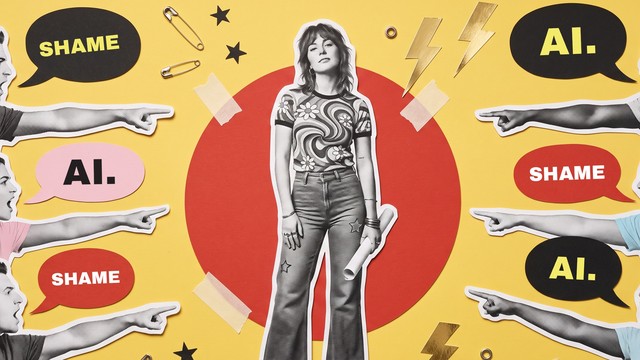
The lead photo was made with AI, and the lettering was set by hand in code.
Keep it loud