The Face Was Always the Product
Hailey Bieber couldn't explain her billion-dollar brand to The New York Times, and the internet is shocked. We've been buying the face, not the formula, since Elizabeth Taylor bottled a diamond in 1991, and the memoir on your nightstand works the same way.
In this feature
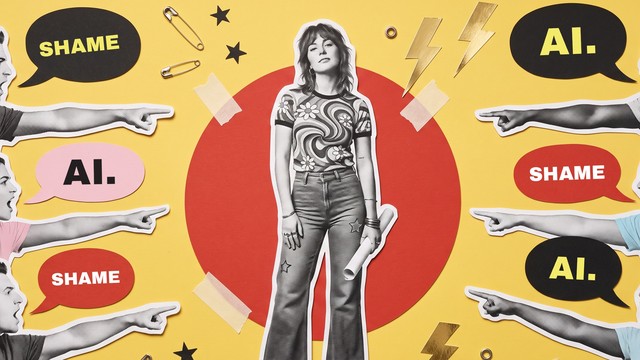
My For You page has turned into a courtroom this week, and the defendant turns 30 tomorrow. Every third video is the same stage at Lincoln Center on Nov. 18: Andrew Ross Sorkin in a suit, Hailey Bieber in a vintage Yohji Yamamoto blazer, and a room full of people who came to the DealBook Summit to hear how you build a beauty brand that e.l.f. buys for $1 billion.
Sorkin asked her how she believed she could get to that number. Her answer was one word. "Delusion." Then she stretched it into a phrase, "optimistical delusion," and the internet did what the internet does. Strangers stitched it, slowed it down, and wrote captions like "She thought this was a podcast." The verdict came back within a day: she doesn't know how her own company works. It didn't help that the money talk was over before the 10-minute mark, and that later she was telling Sorkin she's "still more a Googler" than a ChatGPT girl and picking Instagram over TikTok in the lightning round.
Maybe she doesn't know. But who, exactly, did we think was mixing the moisturizer?
Not Hailey.Not Kylie.Not Rihanna, either.And definitely not Jennifer Lopez, in 2002, in velour.
Before the lip kit, there was a diamond
In 1991, Elizabeth Taylor was about to marry her seventh husband in front of the tabloids, and Elizabeth Arden saw a fragrance in it. The perfume was White Diamonds, created by perfumer Carlos Benaim and launched with a $20 million campaign, a department store tour, and a short film starring Taylor herself. It has sold an estimated $1.5 billion since.
Taylor had opinions about how it should smell, and by most accounts, strong ones. She was not grinding tuberose in a Bel Air kitchen. She was the reason you picked up the bottle, and everyone involved understood that was the job.
Eleven years later, Coty wanted its own Elizabeth Taylor, so it did something no founder myth ever mentions. It test-marketed 20 celebrities with focus groups and picked the one who scored. That was Jennifer Lopez. Glow by JLo arrived in the fall of 2002, made $40 million in its first four months, and became a fragrance franchise that WWD says has done more than $2 billion at retail. Coty's own licensing team created and marketed the scents.
That's not a founder story. That's a casting call.
20 celebrities in Coty's focus groups. One fragrance deal.
Twenty famous people walked into a focus group, and one walked out with a perfume. Nobody called her a chemist. Nobody called her a founder, either. In 2002 we had the honesty to call it what it was: a celebrity fragrance. The name told you exactly what you were buying.
Who made it
Five famous faces, five companies behind them
- 1991White DiamondsElizabeth Ardenface: Elizabeth Taylor
- 2002Glow by JLoCotyface: Jennifer Lopez
- 2015Kylie lip kitsSeed Beautyface: Kylie Jenner
- 2017Fenty BeautyKendo, LVMHface: Rihanna
- 2022Rhodethe Ratnersface: Hailey Bieber
Licensor, manufacturer, incubator or co-founders, as described in this story.
The girl in her bedroom, and the factory in Oxnard
Then the vocabulary changed. Somewhere between the flip phone and the ring light, celebrities stopped licensing their names and started "founding" companies, and the story we were sold got a bedroom.
Kylie Jenner's lip kits sold out in 2015 and became the blueprint. The legend is a teenager with a lip liner and a dream. The paperwork is a company called Seed Beauty, run by John and Laura Nelson, family friends of the Jenners, out of Southern California. When Coty bought 51% of Kylie Cosmetics for $600 million in November 2019, Seed went to court and described itself as the brand's "sole developer, manufacturer and supplier." By its count, the line had more than 800 products that Seed had developed and owned.
The paperwork
Each square is one Kylie Cosmetics product that Seed Beauty said in court it developed and owned. Count from Seed's own filing, 2020.
To be fair to Kylie, she put up about $250,000 of her own modeling money for the first line, and that's real skin in the game. It's also not chemistry. A year after the Coty deal, Forbes took back her "self-made billionaire" title and accused her camp of inflating the company's revenue. The bedroom was always a set.
Rihanna did it with more honesty and a better partner. Fenty Beauty launched in 2017 through Kendo, the beauty incubator owned by LVMH, which also owns Sephora. That's the trick nobody explains on TikTok: the same conglomerate that makes the product owns the store that puts it at eye level. The 40 shades of foundation were Rihanna's point of view, and they changed the industry. The labs, the money, and the shelf were LVMH's, which still owns half the company.
The trick nobody explains on TikTok
Same owner at both ends
Fenty Beauty launched in 2017 through LVMH's incubator, Kendo. LVMH also owns Sephora.
Vision is a real thing. So is a factory. They're just rarely in the same person.
Rhode, and the names you've never heard
Which brings us back to the blazer.
Rhode launched in 2022, and if you only know it from Hailey's bathroom counter, here's the cast list you missed. Rhode has co-founders, Michael D. Ratner and Lauren Ratner. Michael chairs the board. Lauren is the president and chief brand officer, and when the e.l.f. deal closed, Fortune credited her with architecting the brand. There's also a CEO, Nick Vlahos, who came up running big consumer companies. When e.l.f. bought Rhode in May 2025, all three stayed on to run it out of Los Angeles. In the brand's last fiscal year before the sale, it did $212 million in net sales.
THE CAST LIST
- The face
- Hailey Bieber
- Co-founder, the board
- Michael D. Ratner
- Co-founder, president and chief brand officer
- Lauren Ratner
- Chief executive
- Nick Vlahos
$212 million
Lauren Ratner architected a billion-dollar brand, and most of TikTok couldn't pick her out of a lineup.
None of that makes Hailey a mannequin. After the sale she became chief creative officer and head of innovation, with product development, creative and marketing under her. She started talking about skin on YouTube while Rhode was still a concept. And in 2024, Rhode was the No. 1 skincare brand in earned media value, the industry's measure of free attention from posts, press, and people talking. That number is the business. Her face is the marketing department, and it's the most efficient one in beauty.
That's a real skill. She even described the rest of the org chart herself. When Rhode started, she said, it had about seven employees, and she sat in on every hire with her co-founders. Now there's "our wonderful CEO" and an HR department, and she's "not involved really in that side of things anymore." That's not a confession. It's the job description nobody prints on the box.
So what does "businesswoman" even mean?
Here's where I think the confusion lives. We use one word for three very different jobs.
The licensee. A company like Coty or Elizabeth Arden builds the product, makes it, ships it, sells it, and then pays the famous person for her name and face. She approves, she poses, she tours. Elizabeth Taylor and Jennifer Lopez made fortunes this way, and nobody needed to pretend otherwise.
The owner-ambassador. Someone comes to her: an incubator, a manufacturer, a pair of operators with a deck. They bring the formulas, the factories, the supply chain, the retail, and the staff. She brings the audience, the taste and the face, and this time she takes real equity. Kylie, Rihanna and Hailey all live here. They own it. They risk their reputation. The day-to-day company is someone else's job.
The operator. The rare celebrity who actually runs it, who hires and fires, reads the P&L and can tell you her gross margin without a publicist in her ear. These are the ones who can sit across from Andrew Ross Sorkin and enjoy it.
One word, three jobs
What the famous person actually does
Based on the three roles described above. Kylie, Rihanna and Hailey sit in the middle column.
Being the second kind is not a scandal. Calling it the third kind is where the trouble starts.
So let's say what it is. Kylie Jenner is not a businesswoman, not in the way we use the word for the people who actually run things. She's an owner with a famous face and a very good team, and the team stays offstage so she can take the bow. That's fine, by the way. It's a fair trade. The people behind the curtain signed up for it, and they make money doing it. What isn't fine is pretending the curtain isn't there.
I know this from the other side of the table. I've been a graphic designer for 20 years, and I run an agency, which is a polite word for a team that makes things other people put their names on. The logo on the product, the photo on the label, the story on the box: somebody built it in a room nobody photographs, then handed it over. That's the deal. You get paid, and you go home.
I don't resent it. Being behind the scenes is a real job, and a lot of us like it there. What gets under my skin is the second half of the story, the part where the person who brought a face and a name gets introduced as the one who did everything. The designer becomes "her vision." The chemist becomes "her formula." The writer becomes "her voice."
Nobody is lying, exactly. We're just leaving out the credits.
The book was always the product too
Publishing figured this out long before beauty did. A celebrity memoir usually starts as a sale, not a manuscript. An agent sells the idea, the publisher sends over a shortlist of ghostwriters and the famous person picks one, a process one publisher has compared to a mating ritual. Then the writer spends months interviewing, recording, and rebuilding a life into chapters. The New York Post has put the average celebrity job at $75,000 to $100,000 for about six months of work, and ghostwriters will tell you, sometimes on the record, that at least 60% of celebrity books get written this way.
Teresa Giudice is the honest version. She co-wrote her cookbooks, starting with "Skinny Italian" in 2010, with Heather Maclean, and her 2016 prison memoir, "Turning the Tables," with K.C. Baker, a staff writer at People. Both names are on the books. Teresa brought the stories and her mother's recipes. A professional brought the sentences. Everyone knew who did what, and the memoir still reached No. 2 on The New York Times list.
Then there's "Spare." Prince Harry's 2023 memoir was written by J.R. Moehringer, a Pulitzer Prize winner who also wrote Andre Agassi's "Open" and Phil Knight's "Shoe Dog," and who was reportedly paid $1 million for it. His name isn't on the cover.
Same job, two covers
Credited, the way Teresa Giudice's books ran
Uncredited, the way "Spare" ran
Illustrative jackets, not the real covers.
Same job.Same kind of team.One name missing.
That missing name is the whole trick, in books and in beauty. Teresa's publisher printed the credit. Harry's didn't. Rhode puts the Ratners in its press releases, and TikTok still didn't know they existed. The credit line is where the pretending lives, and most of the time we skip it.
Why we keep acting surprised
So why do we all pretend that what isn't, is? The shock isn't really about Hailey. It's about us, and how badly we wanted the bedroom version.
Sorkin handed us the answer himself, halfway through. He quoted Charles Revson, the man who founded Revlon: "In the factory, we make cosmetics. In the store, we sell hope." Then he asked her about filters. The founder myth is the hope part. It's the marketing. A brand that says "a team of chemists and two operators built this with a famous friend" sells moisturizer. A brand that says "she made this because she was tired of dry skin on long flights" sells a person, and a person is what we were buying all along. We followed her, we copied her nails, we bought the lip case for the phone. Then we watched her at DealBook, in a conversation that spent more time on get-ready-with-me videos than on gross margin, and got angry that she couldn't talk like a CFO.
In the factory, we make cosmetics. In the store, we sell hope.
Some people are defending her, and they have a point worth taking seriously. One argument making the rounds says her vagueness was deliberate, that a founder who turns her strategy into a neat framework onstage is handing it to her competitors. Another says women founders get dragged whether they talk numbers or not, and that's true. Nobody asked a male celebrity with a tequila brand to explain agave futures.
The strangest part is that Hailey seems to understand all this better than we do. Early on, she told Sorkin, "Rhode is me, and I am Rhode." Near the end, she said her dream has always been for someone to pick Rhode up at Sephora, not know it's hers and love it anyway, and that over the next couple of decades she expects to "cycle" away from it. Sorkin had already mentioned that e.l.f.'s CEO doesn't like buying celebrity brands, because one famous person becomes the avatar for the whole company. She knows the face is the product. She's already planning for the day it isn't.
Fine. She doesn't owe us her formulas. But then we should stop using the word "built," and so should she. The honest version of the story is better anyway. A famous woman with great instincts found partners who could make the thing, put her face on it, and turned her following into a billion dollars. That's not delusion. That's a business model, and it's older than she is.
Somewhere in Tokyo, Yohji Yamamoto has been designing his own clothes since he founded Y's in 1972, and on Nov. 18 one of his blazers did more talking about craft than anyone on that stage.
On the way out, Sorkin thanked her co-founders, who had been sitting at a table up front the whole time. Nobody clipped that part.
Happy 30th, Hailey. Tell Lauren we said hi.
Keep it loud